
Some Jupiter-sized planets orbit their stars at a fraction of the distance separating Mercury from the Sun, completing a full year in just three to five days. Discovered in 1995, these so-called hot Jupiters were among the first exoplanets ever confirmed, and they immediately upended everything astronomers thought they knew about how planetary systems form. This article examines what hot Jupiters actually are, how scientists detect them, the leading theories about their formation through planetary migration, and what their existence reveals about the surprising variety of worlds beyond our solar system.
What Makes a Planet a Hot Jupiter
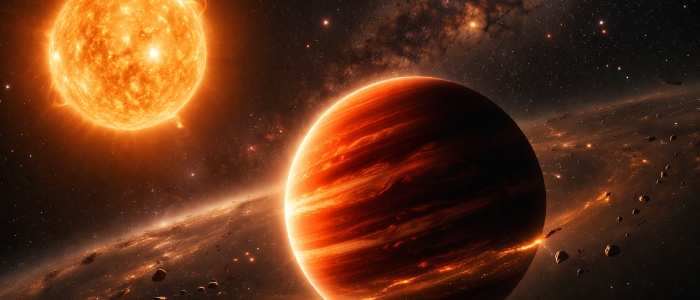
Gas giants that orbit their host stars in under 10 days sit at the extreme end of planetary science. These are hot Jupiters – worlds with masses roughly comparable to Jupiter’s, sometimes larger, yet circling their stars at a fraction of the distance between Mercury and our Sun. The closest known examples complete a full orbit in as little as 18 hours.
Jupiter itself takes nearly 12 years to complete one orbit, sitting about 5.2 astronomical units from the Sun. A hot Jupiter, by contrast, typically orbits within 0.05 astronomical units. At that range, stellar radiation bombards the atmosphere relentlessly, driving surface temperatures above 1,000 degrees Celsius on the dayside. Many of these planets are almost certainly tidally locked, meaning one hemisphere bakes permanently in starlight while the other faces perpetual darkness.
That intense irradiation physically alters the planet. Atmospheres on hot Jupiters tend to be dramatically inflated, puffed outward by heat to densities far lower than models of standard gas giants predict. Some have radii nearly twice Jupiter’s despite similar masses.
Early planetary science, built around the Solar System’s neat architecture, had no framework for any of this. When the first confirmed hot Jupiter, 51 Pegasi b, was announced in 1995, it genuinely puzzled astronomers.
How Astronomers Found Them First
Before the era of space-based observatories, detecting planets around other stars seemed almost impossibly difficult. Yet hot Jupiters turned out to be relatively easy targets, and their discovery reshaped planetary science almost overnight.
Two detection methods drove the early breakthroughs. Radial velocity measures the subtle gravitational tug a planet exerts on its host star, causing the star to wobble slightly toward and away from Earth. A massive planet orbiting close in produces a stronger, faster wobble – one that ground-based spectrographs could actually resolve. The transit method works differently: when a planet crosses in front of its star, it blocks a measurable fraction of the starlight. A Jupiter-sized body passing close to a sun-like star can dim that light by roughly one percent, a signal large enough to detect with precision photometry.
In 1995, Michel Mayor and Didier Queloz announced the discovery of 51 Pegasi b, a gas giant roughly half the mass of Jupiter completing one full orbit every 4.2 days. Nothing in existing planetary theory predicted such a world. Its existence forced astronomers to reconsider where giant planets form and whether our own solar system’s architecture was typical or something of an exception.
Why Giant Planets End Up So Close In
Gas giants almost certainly don’t form where we find them. The temperatures close to a young star are far too high for the icy, volatile-rich material that seeds giant planet formation. Astronomers broadly agree that planets like hot Jupiters coalesced several astronomical units out, in the cooler outer regions of the protoplanetary disk, before something pushed or pulled them inward.
The smoother of the two leading pathways is disk migration. As a young gas giant interacts gravitationally with the rotating disk of gas and dust surrounding its star, it can lose angular momentum and spiral steadily inward over hundreds of thousands of years. This process, called Type II migration, is relatively orderly, and the planet arrives in a tight orbit with a nearly circular path.
High-eccentricity migration tells a more violent story. A gravitational nudge from a companion star or a close encounter with another giant planet can fling a gas giant into a highly elongated orbit. Tidal forces from the host star then gradually bleed off energy, shrinking and circularizing the orbit over millions of years.
Observations suggest both pathways operate. Systems where hot Jupiters orbit well-aligned with their star’s equator point toward disk migration. Misaligned systems, detected through the Rossiter-McLaughlin effect, suggest the chaotic route dominated instead.
These Worlds Changed How We Think About Planetary Systems
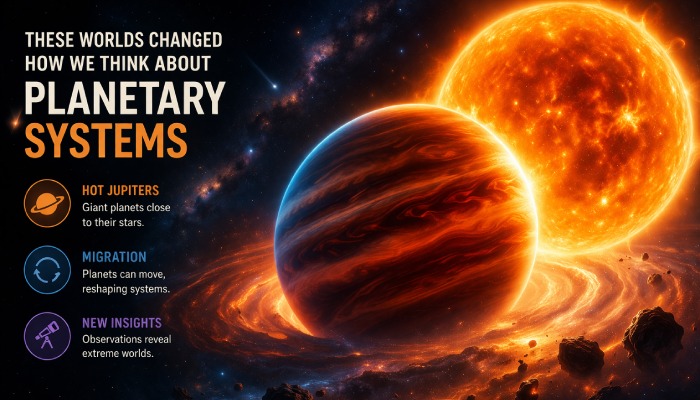
Anyone would not deny after hot Jupiters were sighted that it was time to go back to the drawing board and see how planetary systems evolve and form. Until 1995 the idea prevailing then was that giant planets form far from their stars and plunge into the cold reaches of Icy belts, where material can be stored and accumulates for a lifetime. The confirmation of the existence of a planet as large as Jupiter completing an orbit within just over four days totally shattered this concept. These planets are now understood as evidence indicating that migration is, in fact, a genuine, demonstrable process–one capable of dragging in a giant planet down vast distances into some other distant internal. Smaller rocky planets in the inner system can be swept up with them or possibly expelled. Observations of hot Jupiter atmospheres are currently underway and will continue with more advanced instruments, like the James Webb Space Telescope, to throw precious light on heat redistribution, atmospheric escape, and any effects that tidal forces may impart under the most extreme cases of their pressure. While roving about the annals of these giants, astronomers are learning much on how common it really is for extremes to dislodge an entire orbital configuration. Planetary systems vary, sometimes drastically, with time.